
Architecture
llmprof sits between your app and the provider as a transparent proxy. It forwards every request unchanged (your API key passes straight through) and, on the way, records what the call was made of.
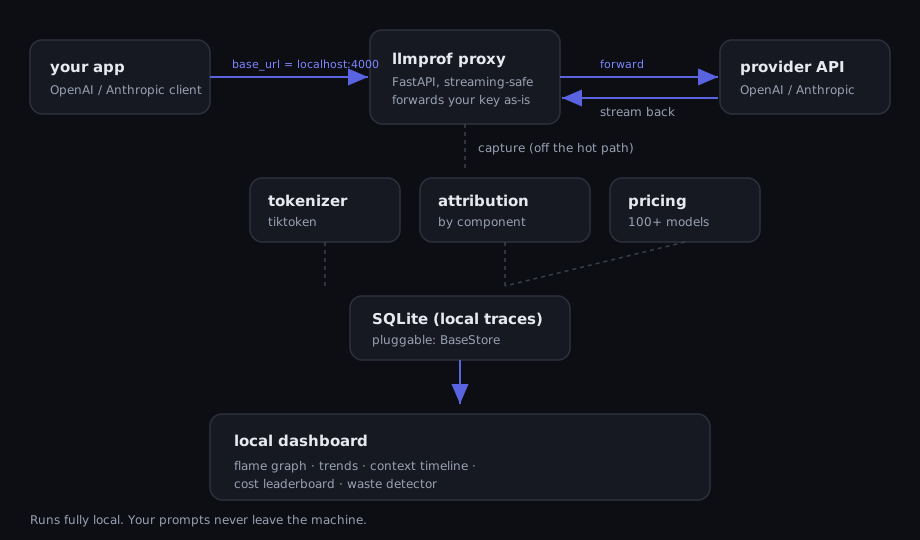
The request path
Section titled “The request path”- Your client calls the proxy instead of the provider (
base_urlpoints atlocalhost). The proxy recognizes/v1/chat/completionsas OpenAI format and/v1/messagesas Anthropic format; anything else is proxied verbatim. - The request is forwarded to the real upstream and the response is streamed straight back. Streaming (SSE) is preserved, so token-by-token output is not buffered or broken.
- Only after the response is on its way back does llmprof do the analysis work, on a background task / threadpool. The proxy adds essentially no latency to your call.
Attribution
Section titled “Attribution”For each captured request, the attribution engine breaks the prompt tokens into the components that make it up:
system promptuser inputhistory (assistant)andtool resultstool schemas- with each individual tool as a drill-down childtool calls
Counts come from tiktoken and are provider-aware (exact for OpenAI models,
a close approximation for others, labeled as such). The result is both a flat
component map and a tree that drives the flame graph.
Pricing
Section titled “Pricing”A pricing table maps each model to input/output dollars per token, so every call gets a cost and the dashboard can project monthly spend. It covers 100+ models and is fully overridable - see Providers & pricing.
Sessions (context creep)
Section titled “Sessions (context creep)”Consecutive calls that extend one another are chained into a run by
fingerprinting the message sequence: if a call’s messages start with a previous
call’s full message list, it is the next turn of that run. This needs no code
change and powers the context timeline. You can also
set an explicit x-llmprof-session header to group calls yourself.
Storage
Section titled “Storage”Traces are written to a local store - SQLite by default, in a single file. The
storage layer is abstracted behind a BaseStore contract, so a centralized
backend (e.g. Postgres for a shared team dashboard) can be plugged in via
LLMPROF_DB_URL without changing anything else. See
Storage backends.
Why local-first
Section titled “Why local-first”llmprof is a focused profiler, not an observability platform. Running locally means zero setup, no data leaving your machine, and a 30-second try. A shared / team tier is a future option layered on the same store abstraction, not a prerequisite.